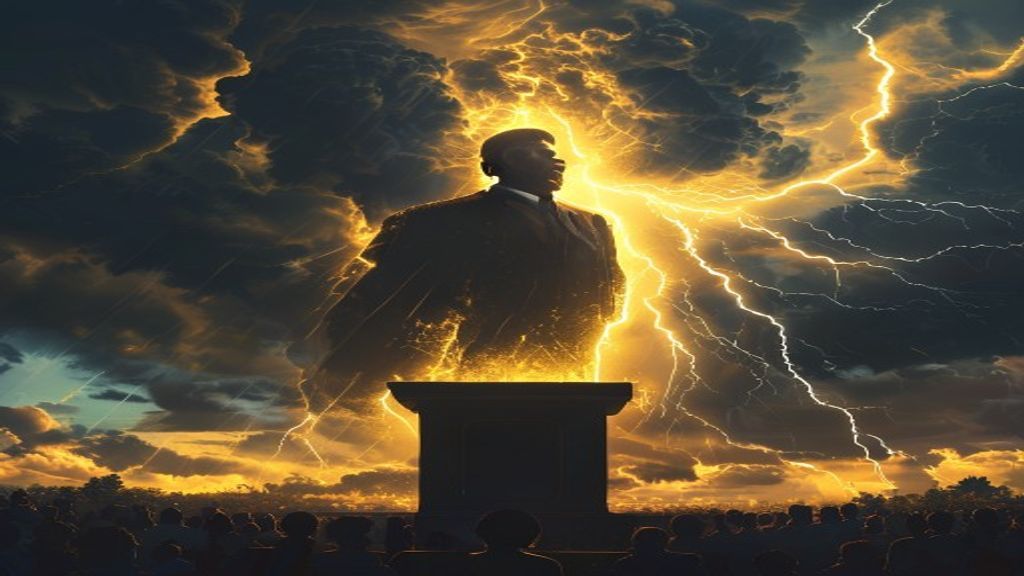
The sky above South Carolina on July Fourth didn’t just threaten; it delivered a furious downpour, mirroring perhaps the tempestuous political landscape former President Trump aimed to navigate. Amidst the thunder and lightning, Trump delivered a speech that wasn’t merely a patriotic observance but a potent reassertion of his ‘America First’ doctrine, touting a past ‘golden age’ and outlining an aggressive political agenda. This wasn’t just a rally; it was a strategic declaration, drenched in both rain and rhetoric.
Beyond the Thunder: Unpacking the ‘Golden Age’ Narrative
Trump’s invocation of a ‘golden age’ isn’t new, yet its timing on America’s independence day carries particular weight. It’s a powerful psychological tool, tapping into a collective nostalgia for a perceived simpler, more prosperous time. But what exactly does this ‘golden age’ entail, and for whom? Our analysis suggests it’s a carefully constructed vision, designed to resonate with specific segments of the electorate.
- Economic Echoes: The ‘golden age’ often refers to periods of perceived economic boom, low unemployment, and manufacturing resurgence. Yet, as Dr. Evelyn Reed, a political economist at the Institute for Public Policy, points out, ‘Defining a ‘golden age’ is inherently subjective. For many, the post-war boom was golden; for others, the tech boom. Trump’s version is laser-focused on a manufacturing-centric, pre-globalization ideal that often overlooks significant societal shifts and economic disparities.’
- Cultural Underpinnings: Beyond economics, the ‘golden age’ narrative implies a return to traditional values, a stronger national identity, and a perceived reduction in societal strife. It’s a direct appeal to those feeling alienated by rapid cultural change and global interconnectedness.
The Political Agenda: A Familiar Blueprint
Despite the meteorological drama, the core of Trump’s message remained steadfastly on-brand. He reiterated calls for stronger border security, a more isolationist foreign policy, and a pushback against what he terms ‘woke’ ideologies. This isn’t just campaign boilerplate; it’s a strategic reaffirmation for his base, signaling continuity and resolve.
‘Trump isn’t just giving speeches; he’s conducting a masterclass in political branding,’ observes veteran political strategist Marcus Thorne. ‘Every word, every phrase, every callback to his previous administration is designed to solidify his image as the uncompromising defender of a particular vision of America. The severe weather only amplified the narrative of a leader standing firm against external forces.’
Why This Matters: The Bigger Picture
A July Fourth speech, even a rain-soaked one, is more than just a campaign stop. It’s a moment for national reflection, and when a prominent political figure uses it to project a specific vision of the past and future, it demands scrutiny. This event highlights several critical trends:
- Rhetoric as Reality Shaping: The constant invocation of a ‘golden age’ isn’t just wistful thinking; it’s an attempt to redefine current challenges and offer a simplified solution set. It frames the present as a deviation from an ideal, requiring a specific, strong-willed leader to correct course.
- Polarization’s Persistence: These speeches often serve to further entrench existing political divides. While inspiring one segment, they inevitably alienate others, making consensus-building even more challenging in an already fractured nation.
- The Enduring Power of Populism: The event underscored the continued potency of populist appeals, particularly those that promise a return to a perceived better past and offer clear, if sometimes simplistic, answers to complex problems.
Financial and Social Impact: The rhetoric itself, particularly around economic policy and trade, can create uncertainty. Businesses, investors, and international partners closely watch these pronouncements for signals on future policy direction. Socially, the constant push-and-pull of competing ‘visions’ for America can exacerbate tensions, impacting everything from community cohesion to national dialogue.
Actionable Takeaways for the Engaged Citizen
As citizens, we must move beyond the headlines and the spectacle. Here’s what to consider:
- Deconstruct the ‘Golden Age’: Ask critical questions. Whose ‘golden age’ was it? What were its limitations? What historical context is being omitted or exaggerated?
- Analyze the Agenda, Not Just the Delivery: Look past the charisma or controversy. What are the specific policy proposals? What would be their real-world impact?
- Seek Diverse Perspectives: Don’t rely on a single source or narrative. Engage with analyses from across the political spectrum to form a more complete picture.
The stormy July Fourth rally was a microcosm of American politics today: dramatic, divisive, and deeply reliant on powerful narratives. Understanding the underlying currents of Trump’s ‘golden age’ rhetoric and political agenda is crucial for anyone trying to make sense of the path ahead for the nation.